Introduction
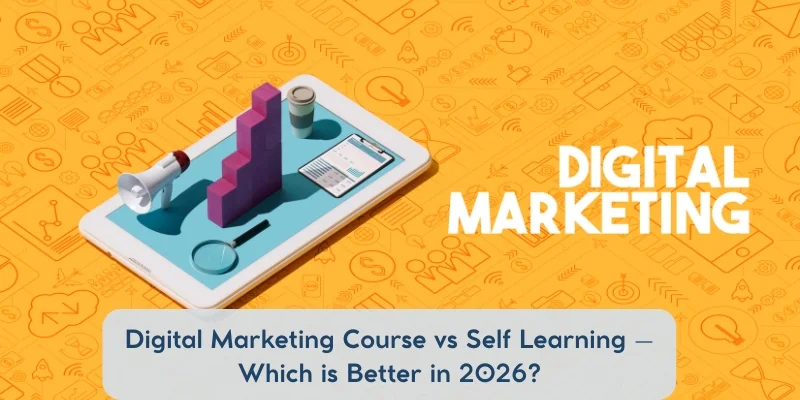
Digital marketing is one of the most valuable skills in today’s online world. But many beginners face a common question—should you join a course or learn on your own? In 2026, both options have become more accessible than ever. The right choice depends on your learning style, goals, and how quickly you want to grow.
What is Self Learning in Digital Marketing
Self-learning means gaining knowledge through free or paid online resources without enrolling in a structured program. Many beginners start by watching tutorials, reading blogs, and experimenting with tools. Platforms like YouTube and blogs provide a huge amount of information for free.
This approach gives you flexibility to learn at your own pace. You can choose topics based on your interest and explore different areas like SEO, content marketing, and social media without restrictions.
What is a Digital Marketing Course?
A digital marketing course is a structured learning program designed by experts. It includes step-by-step training, practical assignments, and guidance from mentors.
Institutes offering a digital marketing course in Chennai or other cities focus on providing real-time experience along with theoretical knowledge. These courses are designed to make beginners industry-ready within a short period.
Advantages of Self Learning
Self-learning has become popular because of its flexibility and accessibility. You don’t need a fixed schedule or large investment to start learning digital marketing.
You can experiment freely, learn from multiple sources, and build your own strategy. Self-learners often develop strong problem-solving skills because they figure things out on their own.
However, the challenge is consistency. Without proper guidance, it’s easy to feel confused or overwhelmed by too much information.
Advantages of Joining a Digital Marketing Course
Joining a course gives you a clear roadmap. Instead of jumping between topics, you follow a structured path that covers everything from basics to advanced concepts.
A digital marketing course in Chennai also provides practical exposure through live projects and case studies. You get access to trainers who guide you, answer your doubts, and help you improve.
Another major benefit is certification. Having a recognized certificate increases your chances of getting a job or clients.
Time Efficiency: Which One is Faster?
If you want to learn quickly and start a career, a course is usually faster. Structured programs are designed to teach you essential skills within a few months.
Self-learning, on the other hand, can take longer because you have to figure out what to learn and in what order. While it offers flexibility, it may delay your progress if you don’t stay consistent.
Cost Comparison: Free vs Investment
Self-learning is mostly free or low-cost, making it attractive for beginners. You can access blogs, videos, and free tools without spending much.
However, a professional course requires an investment. But this investment often pays off through better job opportunities, faster learning, and industry exposure.
Think of it as investing in your future rather than spending money.
Practical Exposure and Real-World Experience
One of the biggest differences is practical experience. Courses provide structured assignments, live projects, and sometimes internships.
Self-learners can also gain experience by working on personal projects, but it requires more effort and direction.
A digital marketing course in Chennai often connects you with real business scenarios, giving you an advantage in the job market.
Career Opportunities and Job Readiness
Employers usually prefer candidates who have both knowledge and practical experience. Courses help you build a portfolio and prepare for interviews.
Self-learners can also succeed, but they need to prove their skills through projects and results. Building credibility takes more time without certification.
Hybrid Learning: The Best Approach in 2026
In 2026, the smartest way to learn digital marketing is by combining both methods. Enroll in a course to build a strong foundation, and then use self-learning to explore advanced topics.
For example, after completing a digital marketing course in Chennai, you can continue learning through blogs, case studies, and real-world experiments.
Role of Tools and Platforms in Learning
Digital marketing involves using various tools for analytics, ads, and content creation. Platforms like Google Analytics and Google Ads are essential for practical learning.
Courses usually teach these tools step by step, while self-learners must explore and understand them independently.
Future of Learning Digital Marketing
The future of learning is becoming more flexible and personalized. With AI, online platforms, and updated tools, both self-learning and structured courses will continue to evolve.
However, practical skills and real-world experience will always remain the key to success in digital marketing.
Conclusion
So, which is better—digital marketing course or self-learning? The answer depends on your goals.
If you want structured guidance, faster results, and job readiness, a course is the better option. If you prefer flexibility and independent learning, self-learning can work for you.
The best strategy is to combine both approaches and continuously improve your skills. In the end, success in digital marketing depends on how much you practice and apply what you learn.